

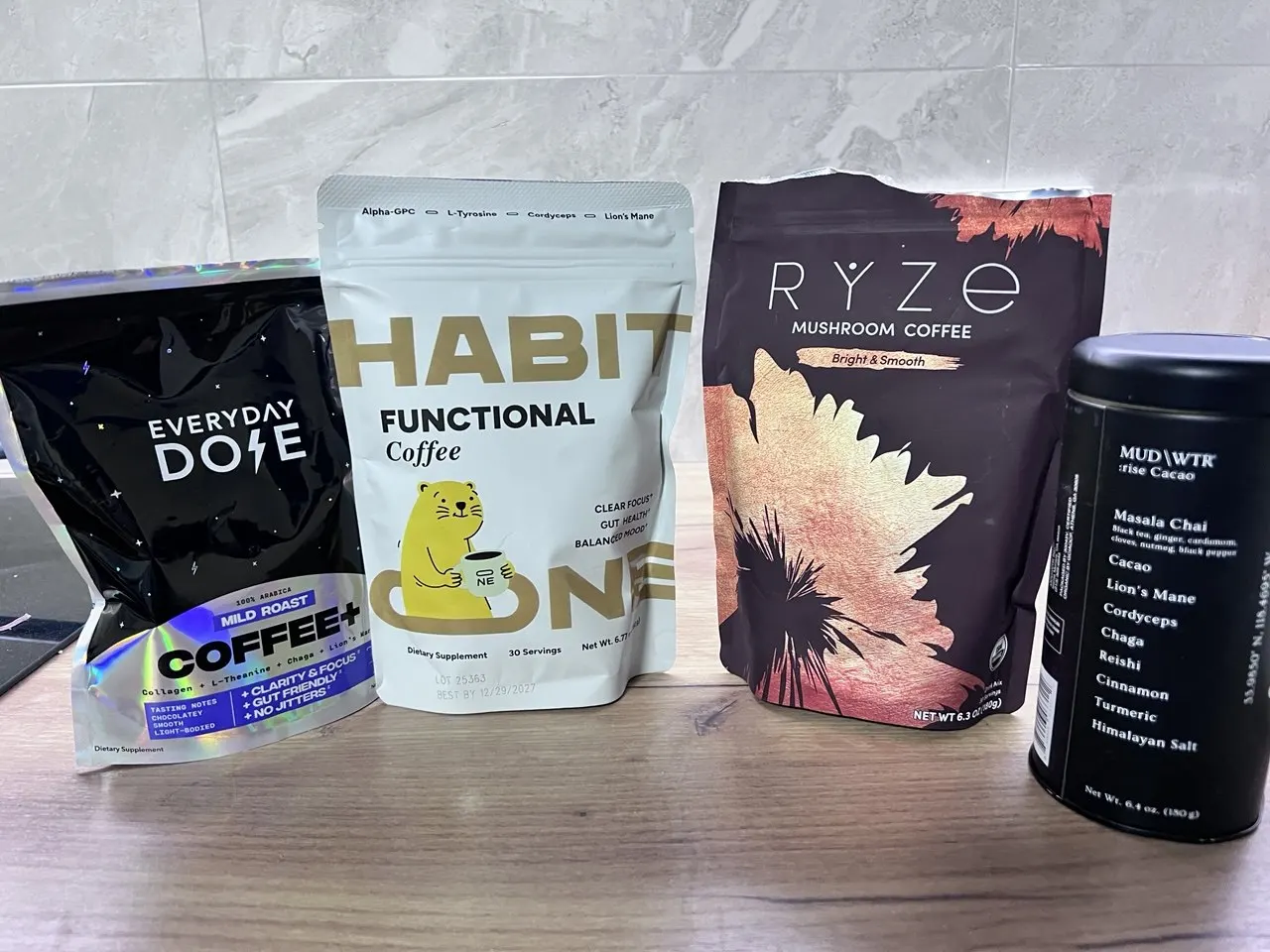
I've been a coffee person for as long as I can remember. My morning cup is as much about the ritual as it is about the caffeine, and for years I never gave it much thought. But sometime in my 40s, coffee started feeling a little different. The energy boost was still there, but so were the occasional jitters, afternoon crash, sensitive stomach, and the nagging feeling that a second cup was affecting my sleep more than it used to.
I probably would have kept ignoring it if a friend hadn't sent me an article about coffee, stress, and energy. That sent me down a rabbit hole. I started reading about coffee alternatives, functional mushrooms, adaptogens, and all the different formulas promising a smoother way to get through the day. I wasn't interested in giving up my morning ritual entirely, and I definitely wasn't looking for something that tasted like grass. I simply wanted something that could give me the energy and focus I rely on coffee for, but in a way that felt a little steadier and gentler.
Mushroom coffee kept coming up, so I decided to see what all the hype was about. But once I started comparing products, I quickly realized that putting a few mushrooms on the front of a bag doesn't necessarily make two formulas comparable.
What to Look for in a Coffee Alternative
Not all coffee alternatives are created equal. Once I started comparing labels, I realized that simply seeing a long list of mushrooms on the front of a bag didn't tell me very much.
Most mushroom coffees use some combination of the same functional mushrooms. Lion's mane is commonly associated with focus and cognitive support, cordyceps with energy and physical performance, while reishi and chaga kept coming up in my research in connection with gut and immune support.
But the more I read, the more I started looking beyond mushrooms. I wasn't just trying to replace caffeine with another source of stimulation—I wanted energy that felt steadier, particularly on stressful days. That's what drew me to formulas that also included adaptogens like Rhodiola rosea or ashwagandha, ingredients often used in formulas focused on stress and fatigue.
I also learned to check how much of each ingredient I was actually getting. Some brands clearly disclose the amount of every mushroom and functional ingredient in the formula, while others group everything into one proprietary blend. When it's all lumped together, it's much harder to know how much of any one ingredient is actually making it into your cup.
Let's Meet the Players
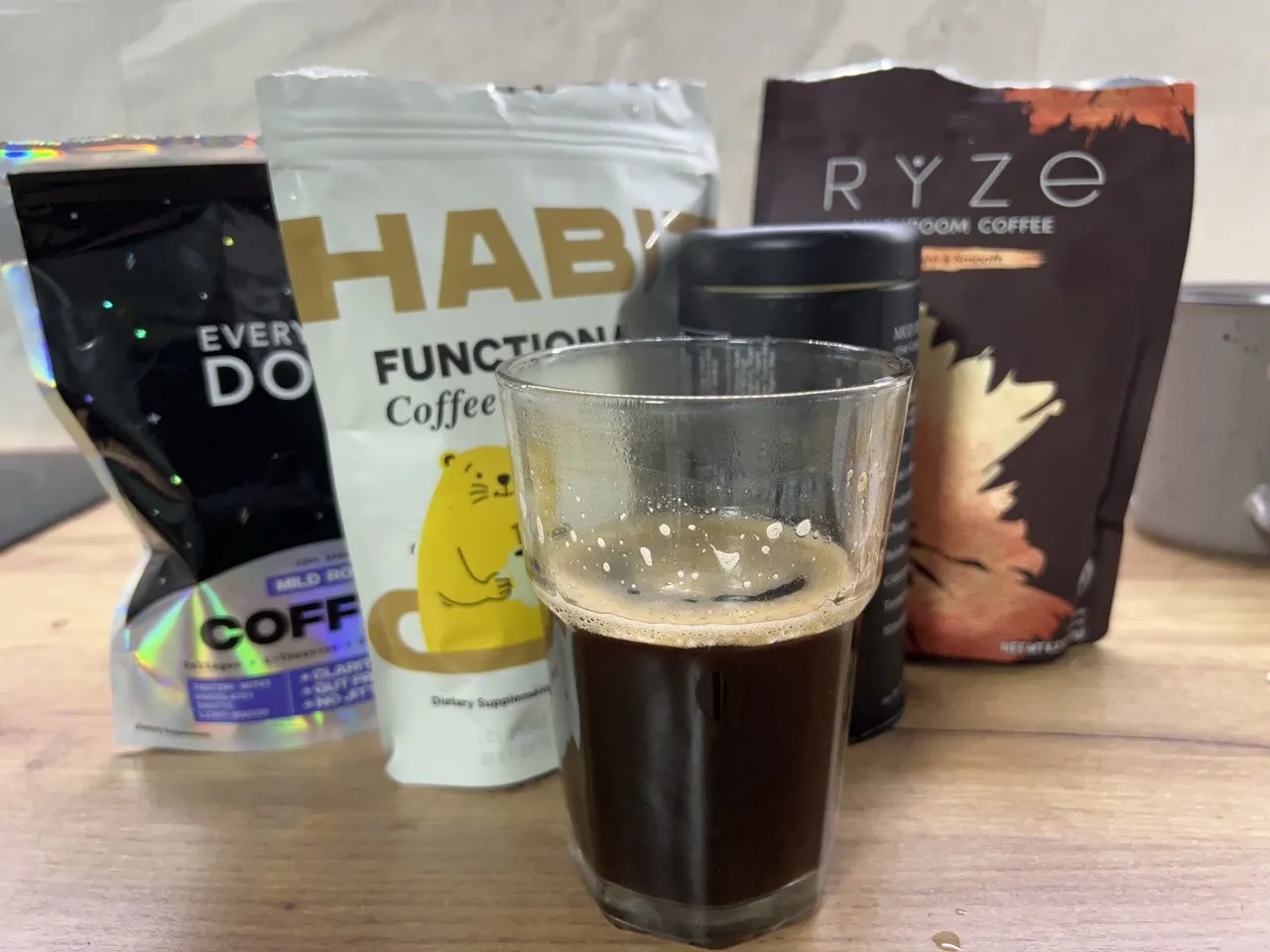
HabitONE
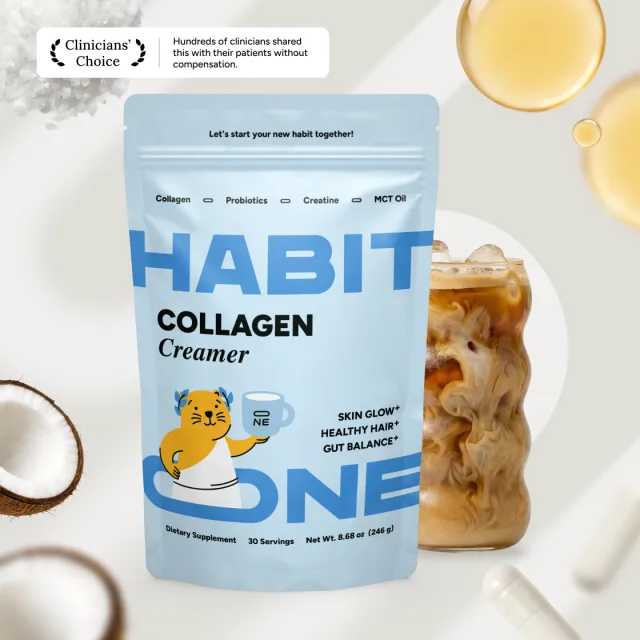
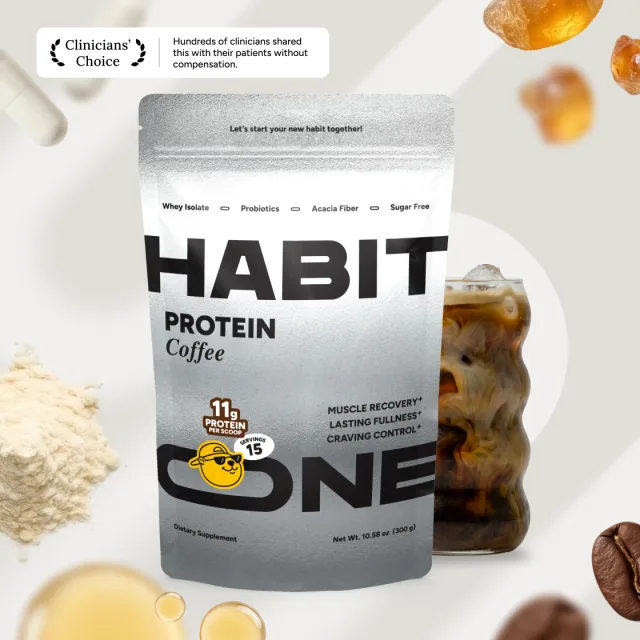
HabitONE uses low-acid Arabica coffee as its base, combined with a 2,650 mg blend of functional ingredients. Of that, 2,000 mg comes from functional mushrooms, evenly split between lion's mane, cordyceps, chaga, and reishi at 500 mg each. The rest of the formula goes beyond mushrooms with a mix of adaptogens and nootropics. It also contains about 85 mg of caffeine per serving.
Ingredients include:
- Low-Acid Arabica: Less acidic coffee base chosen to be gentler on the stomach.
- Lion's Mane: Studied for its potential cognitive and mood-supporting benefits.
- Cordyceps: Studied for its role in exercise performance, endurance, and cellular energy production.
- Reishi: Commonly associated with immune, gut, and relaxation support.
- Chaga: Often associated with gut support and valued as a source of antioxidant compounds.
- Rhodiola Rosea: An adaptogen studied in connection with stress, fatigue, energy, and cognitive performance.
- L-Tyrosine: Studied for supporting aspects of cognitive performance when the brain is under demanding or stressful conditions.
- Alpha-GPC: A source of choline studied for its potential effects on cognitive performance and processing.
Other ingredients: Vitamin B12, Vitamin B3
Shop HabitONE
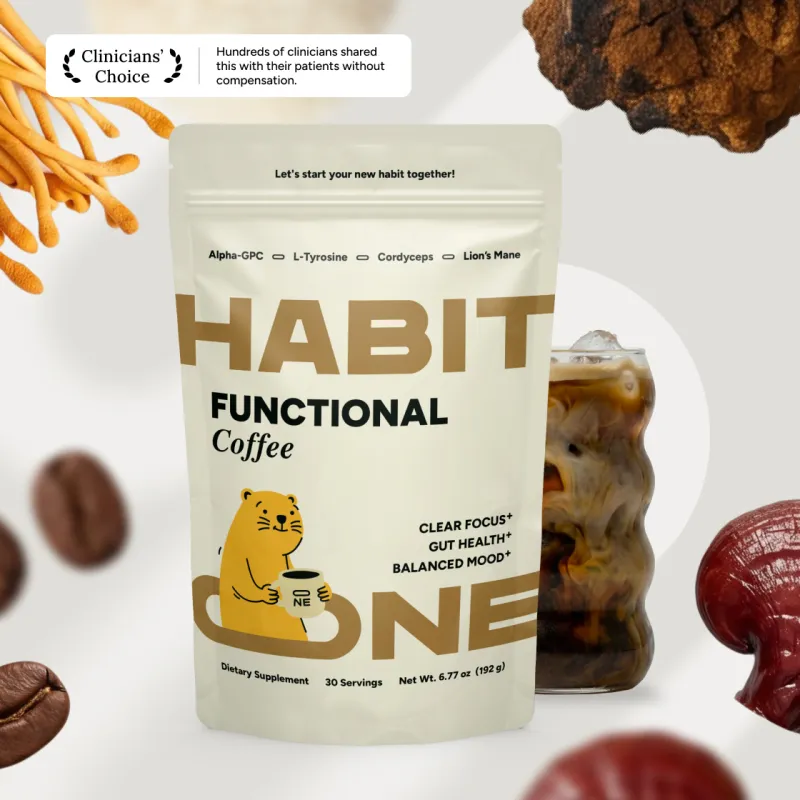
RYZE
RYZE is closer to traditional mushroom coffee. It uses Arabica coffee as its base, available in medium or dark roast, and combines it with a 2,000 mg blend of six functional mushrooms. The brand discloses the total mushroom amount, but not how that dose is divided between the individual varieties. Each serving contains around 50 mg of caffeine.
Ingredients include:
- Lion's Mane: Often studied for its potential cognitive benefits, including focus and mental clarity.
- Reishi: Commonly associated with relaxation and supporting the body's response to stress.
- Cordyceps: Studied in connection with physical endurance and energy metabolism.
- Turkey Tail: Often researched for its beta-glucans and polysaccharides, particularly in relation to immune and gut health.
- King Trumpet: Contains antioxidant compounds that may support overall health.
- Shiitake: A nutrient-rich mushroom commonly studied in connection with immune and cardiovascular health.
MUD\WTR
MUD\WTR takes a different approach from most products in this category because its Original blend doesn't use coffee as the base. Instead, it combines cacao, black tea, spices, and functional mushrooms into a chai-style drink. One serving provides about 35 mg of caffeine.
The formula contains 2,240 mg of functional mushrooms in total, with four varieties included at 560 mg each: lion's mane, chaga, reishi, and cordyceps. I appreciated that the individual mushroom amounts are clearly disclosed rather than grouped together under one total blend.
Ingredients include:
- Cacao: Forms the chocolatey, earthy base of the drink and naturally contains antioxidant compounds.
- Lion's Mane: Commonly researched for its potential role in cognition, focus, and mental clarity.
- Chaga: Often associated with antioxidant and immune support.
- Reishi: Frequently used in functional formulas centered around relaxation, stress, and immune health.
- Cordyceps: Studied for its potential role in physical performance, fatigue, and cellular energy production.
- L-Theanine: An amino acid commonly used in formulas designed to support calmness and attention.
Other ingredients: Black tea, turmeric, cinnamon, and Himalayan salt.
Everyday Dose
Everyday Dose Coffee+ uses Arabica coffee as its base and keeps the formula relatively streamlined, combining coffee with lion's mane, chaga, L-theanine, and collagen protein. The Mild Roast contains about 45 mg of caffeine per serving.
Each serving includes 1,500 mg of fruiting-body mushroom extracts from lion's mane and chaga, plus 4 g of collagen peptides and 210 mg of L-theanine. The brand discloses the total mushroom amount, but not how that dose is split between lion's mane and chaga.
Ingredients include:
- Arabica Coffee: Provides the familiar coffee base and flavor.
- Lion's Mane: Commonly studied for its potential role in focus, memory, and cognitive function.
- Chaga: Often associated with antioxidant, immune, and gut-health support.
- L-Theanine: An amino acid frequently used alongside caffeine for a calmer, more focused energy profile.
- Collagen Peptides: Grass-fed bovine collagen that adds protein and is commonly associated with skin, hair, nails, joints, and connective-tissue support.
Other ingredients: None.
Taste
HabitONE
HabitONE came the closest to my usual cup of black coffee. It was smooth and familiar, with only a faint earthy, almost forest-like note in the background that made it taste a little different—in a good way. Overall, it was a surprisingly familiar and enjoyable cup.
I also tried it with a splash of creamer, and it tasted almost like my usual latte. In both cases, the mushroom flavor stayed very subtle and was mostly masked by the coffee. This was the first one that genuinely felt like I could swap it into my morning routine without feeling like I was giving up coffee. I found myself wanting another cup when I finished the first.
RYZE
Little hard to describe because, to me, it simply tastes distinctly mushroom-forward. There's an earthy flavor and aftertaste that makes it feel quite far from a typical cup of black coffee. A splash of creamer and a little sugar made it much more palatable, but that earthy finish still came through.
MUD\WTR
The least coffee-like of the group for me. The mix of cacao, black tea, turmeric, cinnamon, and spices gave it a peppery, chai-like flavor that reminded me much more of masala chai than coffee. I can see the appeal if that's the flavor profile you enjoy, but as someone who still wants my morning drink to taste like coffee, this one just wasn't for me.
Everyday Dose
With just water, Everyday Dose tasted a little too light for me, almost like watered-down coffee with a slightly oily finish. It wasn't unpleasant, but it wasn't something I found myself craving either. Adding milk and a little sugar made it much more enjoyable, though on its own it didn't quite have the richness I look for in my morning coffee.
Effects
HabitONE
The first day I used HabitONE, the biggest difference I noticed was in my overall energy and focus throughout the day. Usually, I start craving another cup of coffee around 2 PM, when my concentration drops and I get a little restless. On the days I drank two cups of HabitONE—one in the morning and one around midday—I felt a steadier level of energy that lasted until around 6 PM, without the anxious feeling I sometimes get from regular coffee.
Some of that effect on my focus may come from L-Tyrosine and Alpha-GPC, two ingredients that have been studied for their potential role in cognitive performance through different pathways. It's also worth noting that these compounds may have more noticeable effects with consistent use, so a longer testing period might have helped me see even more of a difference.
Another surprise was how it felt on my stomach. I drank HabitONE on an empty stomach, as I normally do with coffee, and noticed much less bloating and fewer of the sudden bathroom trips I sometimes experience afterward. I can't say for certain what made the difference, but the low-acid coffee base, combined with chaga and reishi, was one of the reasons the formula had caught my attention in the first place.
RYZE
RYZE gave me a small lift in energy, but the effect felt fairly short-lived and much closer to a light cup of coffee than anything noticeably different. I felt a little more awake after drinking it, but I didn't get the same sustained focus I was hoping for.
When I looked back at the formula, I noticed the 2,000 mg mushroom blend is spread across six different varieties. Since RYZE doesn't disclose the amount of each individual mushroom, it's impossible to know how much lion's mane—or any of the others—you're actually getting per serving. For me, the overall effect felt more like diluted coffee with mushrooms added than a distinct cognitive boost.
The upside is that I still got some energy with less caffeine than I'd normally drink, but the effect itself wasn't especially memorable.
MUD\WTR
MUD\WTR was a bit harder for me to judge. With only around 35 mg of caffeine per serving, I wasn't expecting the same kind of lift I normally get from coffee. On the first day, I did feel slightly more alert after drinking it, although I honestly couldn't tell how much of that was the drink itself versus simply expecting to feel something.
By the second day, the effect was much less noticeable. I didn't really get the energy boost I was looking for, and by early afternoon I found myself wanting an actual cup of coffee. I can see the appeal for someone specifically trying to cut caffeine, but for me it felt more like a comforting functional drink than a true replacement for my morning coffee.
Everyday Dose
Everyday Dose gave me a decent lift in energy, but it felt mostly like the effect of caffeine rather than anything especially noticeable from the functional ingredients. With only two mushrooms and no individual dosage breakdown, it was hard to tell what role they were actually playing.
The bigger issue for me was my stomach. The collagen and MCTs didn't sit particularly well, and I noticed more digestive discomfort after drinking it. The energy was there, but it wasn't the gentler experience I was looking for.
Cost
HabitONE: You can choose between a one-time purchase or a subscription. A 30-serving bag costs $45, or about $1.50 per serving. With a subscription, the price drops to $29 per month, or roughly $0.97 per serving. There are also 2- and 3-month options, which bring the price per bag down if you prefer to stock up.
RYZE: RYZE is subscription-based, starting at $27 for the first month and increasing to $36 per month after that.
MUD\WTR: MUD\WTR also uses a subscription model, starting at $34 for the first month and increasing to $40 per month afterward.
Everyday Dose: Everyday Dose starts at $27 for the first month, with the subscription renewing at $36 per month after that.
The Verdict
Because of the taste and the steady focus I experienced, HabitONE was the clear winner for me. It came closest to my usual cup of coffee, but the formula felt more thoughtful: meaningful doses of functional mushrooms, added adaptogens and nootropics, and enough transparency to know exactly what I was drinking.
I also noticed that it felt much gentler on my stomach, even when I drank it black and on an empty stomach. Less bloating and fewer sudden bathroom trips was a pretty meaningful win for me.
I'm not ready to give up my usual coffee entirely (no one can take it from me!!!) but HabitONE feels like a great option for days when I want steadier energy or when my stomach simply isn't cooperating. I also really liked it as a second cup in the afternoon: enough of a lift to keep me going, without making it harder to wind down later. It's definitely earned a place in my weekly routine, and I'm curious to see whether the benefits become even more noticeable with more consistent use.
Try out HabitONE for yourself for focus and calm gut