

Nearly two-thirds of American adults drink coffee every day, and for most of us it’s non-negotiable. But a growing number of coffee lovers are running into the same wall: the caffeine that used to feel like a clean lift now comes with jitters, an afternoon crash, disrupted sleep, or a stomach that feels acidic and off. That tension — love the ritual, tolerate the side effects less and less — is exactly why “mushroom coffee” has gone from health-store curiosity to one of the fastest-growing corners of the functional-beverage aisle.
But the category is genuinely confusing. Slapping a few mushroom names on the front of a bag doesn’t make two formulas comparable, and the health claims range from reasonable to wildly overstated. So we did the work: we dug into the research, looked at what registered dietitians and physicians actually say (not just what brands claim), and built a buyer’s guide to help you choose a mushroom coffee that fits your goals.
Meet the Experts
This guide is informed by the expert perspective of Sharon Lehman, RD (Registered Dietitian & Nutrition Writer) and Jamé Heskett, MD (Integrative Medicine Physician).


What Is Mushroom Coffee — and Why Are People Making the Switch?
Mushroom coffee has gone from health-store curiosity to one of the most talked-about wellness drinks in recent years… and for good reason. At its core, it’s regular coffee blended with extracts from functional mushrooms — most commonly lion’s mane, cordyceps, reishi, and chaga (some blends swap the coffee for a cacao-and-chai base). To be clear, these are functional mushrooms, not the psychedelic kind; there’s nothing intoxicating about it. The catch is that the drink most of us reach for first thing — regular coffee — often comes with tradeoffs: a jittery spike and crash, and a stomach that can feel acidic and off.
Making the switch isn’t the compromise you might expect: a good coffee-based blend still tastes like coffee, and the mushrooms bring their own upside. As Sharon Lehman, RD, notes, “both mushrooms and coffee beans have compounds with antioxidant properties that help protect the cells of your body from damage,” and there’s “evidence suggesting the fiber content in functional mushrooms can support gut health.”
Beyond the smoother cup, Heskett points to the functional ingredients as the real draw. “Cordyceps and lion’s mane would be my top two,” she explains, “because they both work on different aspects of energy and so you would likely get a synergistic effect.” The goal isn’t a bigger jolt — it’s a steadier, calmer kind of energy.
Like any functional drink, consistency matters. Heskett credits regular use of cordyceps for a real, felt change — “I can feel my stamina for physical activity really improving” — which makes mushroom coffee less of a one-cup fix and more of a daily habit.
Who Should Consider Drinking Mushroom Coffee?
Almost anyone who loves their morning coffee can make the switch, but certain people will notice the biggest difference.
Because the whole appeal is a gentler, smoother cup, the best candidates are coffee drinkers whose usual cup has started working against them: anyone who gets jittery, anxious, or crash-y by the afternoon, and anyone whose stomach reacts to coffee with acid reflux, heartburn, or bloating. It’s also a natural fit for those who want steadier energy on stressful days, and for anyone who wants more from their morning cup than a quick jolt.
That said, mushroom coffee isn’t a magic bullet — it works best as one piece of an already-balanced routine, not a fix for everything else. And a few groups should check with a doctor before switching: anyone pregnant or breastfeeding, or on blood thinners or immunosuppressants (reishi can interact with these).
How to Choose the Best Mushroom Coffee
Putting a few mushroom names on a bag doesn’t make two blends equal. A handful of things separate a formula worth drinking from an overpriced one:
- Disclosed doses, not a “proprietary blend”: The best brands list how much of each mushroom you get (say, 500 mg of lion’s mane). If it’s lumped into one total, you can’t tell what you’re paying for.
- A low-acid coffee base: If gut comfort is the goal, this matters as much as the mushrooms.
- Quality you can verify: Look for fruiting-body extracts (richer in the active beta-glucans than grain-grown mycelium) and third-party testing for potency and contaminants.
- More than mushrooms: Adaptogens and nootropics like Rhodiola, L-theanine, or L-tyrosine can round out the formula — as long as they’re dosed and disclosed too.
- A cup you’ll actually keep drinking: Prioritize a taste you enjoy and a subscription you can leave; a common complaint in this category is a “starter” price that jumps on renewal.
The Best Mushroom Coffees in 2026
We’ve assembled some of the best mushroom coffees on the internet for every kind of coffee drinker.
Best Mushroom Coffee for Everyday Drinking
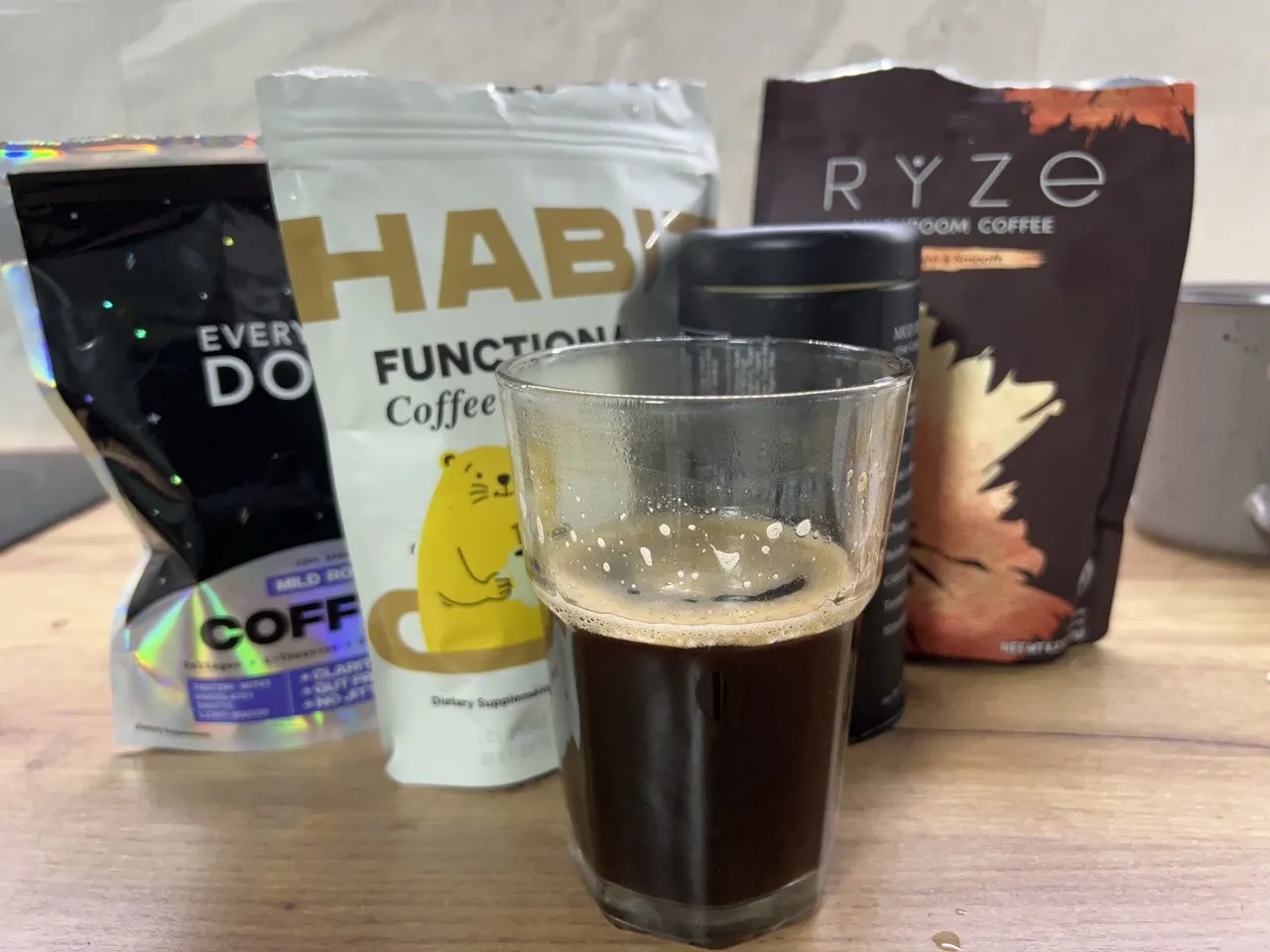
If you want one mushroom coffee that checks every box, this is it. HabitONE is built on a low-acid Arabica base and packs the most complete, most transparent formula I tested: a 2,650 mg functional blend with four mushrooms fully disclosed at 500 mg each — lion’s mane, cordyceps, chaga, and reishi — plus adaptogens and nootropics (Rhodiola, L-tyrosine, Alpha-GPC) the others leave out. It was also the one that actually tasted like the regular coffee I already drink, and the one that felt genuinely gentler on my stomach. On subscription it comes to about $0.97 a serving, and — unusually for this category — the price doesn’t jump on renewal.
The Classic Mushroom Coffee
The most straightforward pick for dipping a toe into the category. RYZE uses an Arabica base with a 2,000 mg blend of six mushrooms, and I got a mild lift from it — though the flavor leaned earthy, and the energy faded faster than I’d hoped. The catch is transparency: the blend isn’t broken out by mushroom, so you can’t see how much lion’s mane you’re actually getting. It’s often the cheapest on the first order, but it’s subscription-only, and the price climbs after that.
Best Non-Coffee Alternative
Not coffee-based, and proud of it. MUD\WTR swaps the coffee for a cacao-and-chai base (it still carries a little caffeine — about 35 mg from the cacao and black tea), with four mushrooms clearly disclosed at 560 mg each. I liked that the doses are transparent, and the spiced, masala-chai flavor is genuinely pleasant — but it reads more like a warm chai than a morning coffee, so it’s the pick for someone who wants to move away from a coffee-style cup rather than replace it like-for-like.
Best With Added Collagen
An Arabica base kept simple: lion’s mane and chaga (1,500 mg total, though not split out), plus 4 g of collagen and L-theanine. The collagen is a nice bonus if it’s something you’d buy anyway, and it gave me a decent lift. The downsides for me were the watery, slightly oily cup on its own — and that the added collagen sat less easily on my stomach than the others.
Frequently Asked Questions
Is it okay to drink mushroom coffee every day?
For most healthy adults, yes — it’s a food, and the functional-mushroom benefits that have any evidence tend to require consistent use. If you’re pregnant, on medication, or managing a condition, check with your doctor.
Does mushroom coffee actually work?
For the simple stuff — a lower-acid cup that’s easier on the stomach and a calmer, steadier lift — many people notice a difference quickly. For the bigger cognitive and performance claims, the evidence is emerging, and strongest for cordyceps with consistent use. Manage expectations accordingly.
Will it help with bloating or reflux?
It’s one of the most common reasons people say they switched. Across real reviews, “less bloating” and “my acid reflux is gone” come up again and again — most likely because a lower-acid cup is gentler on the stomach than regular coffee. It’s not a guarantee, and results vary, but if coffee currently leaves you bloated or refluxy, it’s one of the most reported wins.
Can I drink it like regular coffee?
Yep. Brew it as directed, add your usual milk or creamer, or pour it over ice — the better coffee-based blends are built to slot into your existing routine, not to replace the ritual.
Does it taste like mushrooms?
The best coffee-based blends taste mostly like coffee with a faint earthy note. Non-coffee blends (like a chai base) taste quite different — that’s a preference, not a flaw.
Why You Should Trust Us
We research functional-beverage products with a focus on ingredient transparency, real evidence, and everyday usability — not hype. For this guide we compared formulas and per-mushroom dosing across the leading brands, tested them ourselves, and checked the health claims against published research and the positions of registered dietitians and physicians rather than marketing copy. When the science is unsettled, we say so.
See why HabitONE is our top mushroom coffee pick